
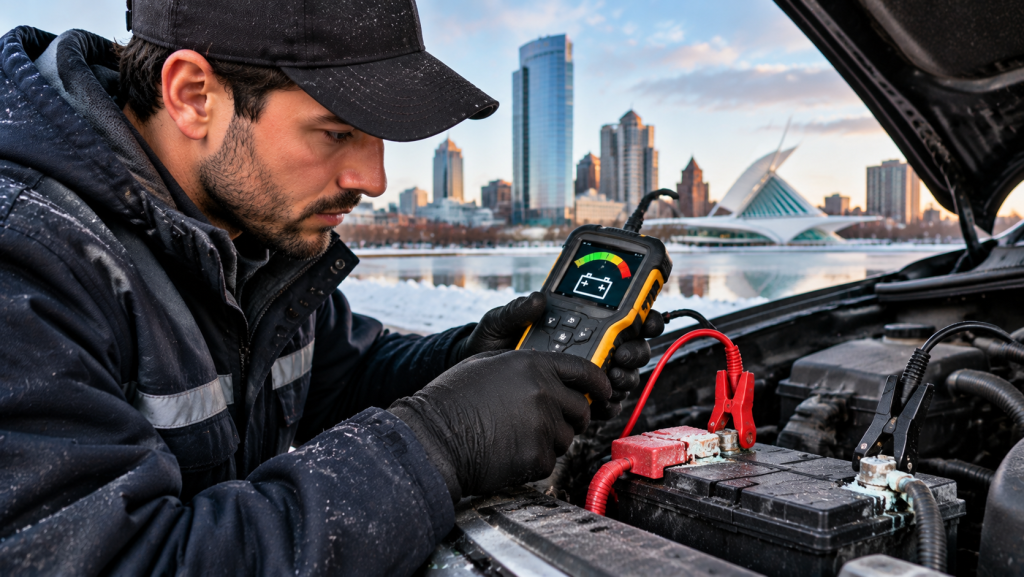
Every year, the first truly cold morning in Milwaukee brings the same wave of dead batteries. A car that started fine all fall suddenly clicks, cranks slowly or does nothing at all. The battery did not fail overnight. It was likely weakening for months, and the cold simply exposed it. Cold makes a battery less able to deliver power at the same moment it makes the engine harder to turn over, so a battery that is just good enough in October can be a problem in January. That is why fall is the right time to test your battery, while the weather is mild and you can choose when to deal with it. This guide explains why the cold is so hard on batteries, what cold cranking amps mean, how battery testing works, the warning signs to look for and how to keep your battery healthy through winter. If you are searching for a car battery test in Milwaukee, here is a plain language overview.
Why Cold Weather Is Hard on Batteries
A car battery produces power through a chemical reaction. Low temperatures slow that reaction, so a cold battery cannot deliver as much current as a warm one. At the same time, cold thickens engine oil and makes the engine harder to turn, so the starter asks the battery for more power than usual. The two effects meet right at startup.
- Less available power. The battery’s output drops as temperatures fall.
- More demand. The starter needs extra effort to turn a cold engine.
- Extra loads. Heated seats, defrosters, lights and wipers all draw power in winter.
- Short trips. Quick drives do not give the alternator enough time to recharge the battery after a start.
- Summer damage shows up late. Heat in the warm months can wear down a battery internally, and the weakness often goes unnoticed until the cold arrives.
Our guide to lake effect winters and preparing your car for Milwaukee’s cold covers the larger picture of getting a car ready for the season, and the battery is a key piece of it.
What Cold Cranking Amps Mean
You may have seen the letters CCA on a battery label. It stands for cold cranking amps, a rating of how much current a battery can deliver at a low temperature for a short time while still keeping adequate voltage. In simple terms, it is a measure of starting strength in the cold. A higher rating generally means more starting power, but the right number depends on your vehicle and engine.
- Use the rating your vehicle needs. Your owner’s manual or the label on the current battery lists the recommended specifications. A technician can confirm the right match.
- Do not go below the recommendation. A battery that is too weak for the car will struggle in cold weather.
- Size and type matter too. The battery must fit the tray and terminals, and some cars, especially those with start stop systems, require a specific type.
- The rating is a new battery measure. A battery’s real world performance declines with age, which is why testing matters.
Why Fall Is the Right Time to Test
- You find problems before they strand you. A weak battery caught in October is an easy fix. A dead battery on a snowy morning is not.
- You choose the timing. Replacing a battery on your schedule beats an emergency call in the cold.
- You catch hidden summer wear. A battery that has been through hot months may be on its way out.
- You can check the charging system too. A weak alternator can mimic a bad battery, and a test can tell them apart.
- You prevent a chain reaction. Repeated weak starts can strain the starter and other parts.
Warning Signs of a Weak Battery
- Slow cranking. The engine turns over sluggishly, especially on cold mornings.
- Clicking when you turn the key, without the engine starting.
- Dim headlights or interior lights, particularly at idle or when starting.
- A battery or charging warning light on the dashboard.
- Electronics that act strangely, such as a radio that resets or a clock that loses its setting.
- Corrosion on the terminals, a white, blue or green crust.
- A swollen or bulging battery case, which can be caused by heat or failure.
- A rotten egg smell, which can point to a leaking battery.
- Age. If you do not know how old the battery is, find the date label, or ask a technician to check.
- Frequent jump starts.
A battery can fail with no warning at all, which is another reason to test rather than wait for symptoms. If the battery warning light comes on while driving, there may be a charging problem, and you should have it checked soon.
What a Battery Test Involves
- Visual inspection. The technician checks the case, terminals and cables for damage, corrosion and looseness.
- Resting voltage check. A multimeter shows the battery’s state of charge when the car is off.
- A load or conductance test. A battery tester measures how well the battery can deliver current, often compared with its rated capacity. This is the best way to judge health.
- A starter and charging system test. The technician checks that the starter draws normal current and that the alternator charges properly while the engine runs.
- A parasitic drain check, if needed, to find something that drains the battery while the car is off.
- A report on the result. Many testers give a clear result, such as good, weak or replace, along with a measurement.
Do not rely on a voltage reading alone. A battery can show normal voltage and still fail under load.
Battery or Something Else?
Starting problems are not always the battery. A bad alternator, corroded or loose cables, a failing starter, a blown fuse or a parasitic drain can look the same. A test that covers the whole starting and charging system gives you a reliable answer and prevents buying a battery you did not need.
Safety When Working Around Batteries
- Wear eye protection and gloves. Battery acid is harmful to skin and eyes.
- Keep sparks and flames away. Batteries can give off flammable gas.
- Turn the car off and remove metal jewelry before working near the battery.
- Do not jump start or charge a battery that is cracked, swollen, leaking or frozen.
- Follow your owner’s manual for jump starting, battery location and any special procedures, since some vehicles have remote terminals or a battery in the trunk or under a seat.
- Dispose of old batteries properly. They are recyclable and should not go in regular trash. A technician will usually take the old one.
Keeping Your Battery Healthy in Winter
- Test it in the fall, and have it checked again if the car shows symptoms.
- Keep the terminals clean and tight.
- Make sure the battery is secured so vibration does not damage it.
- Take longer drives now and then, so the alternator can fully recharge the battery.
- Limit electrical loads when starting the car, such as heated seats, the defroster and the stereo.
- Park in a garage when you can, which helps the battery stay warmer.
- Consider a battery maintainer if the car sits for long periods, following the manufacturer’s instructions.
- Replace an old battery before it fails. Do not wait for a cold snap.
- Have the charging system checked if the battery keeps running down.
For a broader checklist, our car winterization FAQ answers common questions about what else to do before the cold sets in, from fluids to tires and more.
When to Replace Rather Than Recharge
A battery that is simply discharged can often be recharged and returned to service. A battery that tests weak, has bad cells, is physically damaged or fails repeatedly should be replaced. Your owner’s manual and a technician can help you choose the right replacement for your car, including the correct size, terminal layout and type, and the cold cranking rating the vehicle needs. If you drive an electric or hybrid vehicle, remember that the small 12 volt battery still needs attention, and the high voltage system should only be handled by qualified technicians.
Mobile Battery Service in Milwaukee
A battery test and replacement is one of the most convenient jobs for a mobile mechanic. A technician can come to your home or workplace in Milwaukee, test the battery, starter and charging system, clean the terminals and install a new battery on site, so you do not have to arrange a tow or wait in a shop. Most vehicles allow this. Some cars hide the battery under panels or in unusual places, and some need the car’s computer to register a new battery, which can take extra steps or equipment. A good technician will tell you before starting what your car needs.
Quick Summary
- Cold weakens batteries and makes engines harder to start, so weak batteries fail first.
- Cold cranking amps measure starting power in the cold, and your vehicle has a recommended rating.
- Fall is the best time to test, before you are stranded.
- A proper test checks the battery, starter and charging system, not just voltage.
- Use eye protection, avoid sparks and never jump a damaged battery.
- Mobile service can test and replace most batteries at your home.
A quick test now can save you from a frozen morning and a call for help. If you would like your battery checked, visit the Mobile Mechanic Pros of Milwaukee homepage to learn more, or contact us to schedule a visit.